
Recycling Information
2025 Solid Waste and Recycling Dashboard Metrics
 Farmington 2025 Solid Waste and Recycling Dashboard Metrics
Fats, Oils and Grease Prevention Protects the Environment
Excessive fats, oils and grease in sewer pipes, referred to as FOG, blocks pipes and can create pollution problems. FOG enters sewer pipes through restaurant, residential and commercial sink drains. Once in the sewer, FOG sticks to the pipe, thickens, and can eventually block the entire pipe. Blockages in sewer pipes can send sewage backward up floor drains in homes and/or out of manholes into streets and rivers. These sewage overflows pollute our homes and our environment.
 Click here for the printer-friendly FOG Brochure
Farmington Introduces Food Waste Recycling
Food waste recycling has been added to the city’s existing yard waste collection program. This initiative allows residents to place household food scraps directly into their yard waste containers for weekly curbside pickup. Instead of sending organic materials to landfills, where they generate harmful greenhouse gases, residents can now help transform these materials into nutrient-rich compost used in gardens, landscaping, and city projects.
Food is the single largest category of material found in U.S. landfills. Once buried, it breaks down into potent gases such as methane. By composting food scraps alongside yard waste, the city will help reduce emissions while producing a valuable soil amendment.
A Proven Model for Success
The City of Farmington previously partnered with RRRASOC and My Green Michigan in a Food Waste Pilot Program launched in fall 2025. The pilot, staged at Riley Park, operated successfully through fall and winter. Since the start of the program, residents diverted nearly 22,000 pounds of food waste from landfills. Last year, the City’s overall recycling rate of 49.3 percent—significantly higher than the Michigan average of 25 percent and the national rate of 32 percent. The program demonstrated strong community participation and measurable environmental impact.
How Residents Can Participate
The process begins at home. Residents can collect food scraps in the kitchen and add them to their yard waste container or paper yard waste bags.
For residents who live in apartments or outside the curbside collection area, food scrap bins will continue to be available at Riley Park in downtown Farmington, 33113 Grand River Ave. Biodegradable bags for storing and transporting food scraps are available at Farmington City Hall.
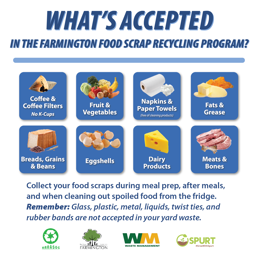
- Accepted food scraps include:
- Fruits and vegetables
- Dairy products
- Meat, bones, and eggshells
- Coffee grounds and filters
- Tea leaves and tea bags
- Breads, grains, and spoiled food
Keeping contaminants out of the compost stream ensures a clean, high-quality finished product.
Where the Material Goes
Farmington’s curbside contractor, WM, currently transports collected yard waste to the Spurt composting facility in Wixom. WM has agreed to include food waste with Farmington’s yard waste deliveries, and Spurt has confirmed it will accept the combined material.
RRRASOC Announces New App
Household Hazardous Waste
Please click here for the Household Hazardous Waste event schedule
Shredded Paper
Shredded paper placed into paper bags and into the recycling cart results in those bags opening or tearing, which causes the shredded paper to become mixed with other recyclables. Therefore, the shredded paper becomes uncapturable and constitutes a contaminate to those other materials.
Shredded paper placed in plastic bags is also problematic in that the plastic bag constitutes a contaminate. Plastic bags also reduce operational efficiencies and increase facility costs.
RRRASOC does offer personal document shredding (no businesses) to community member residents at the self-serve industrial paper shredder located at the RRRASOC Materials Recovery Facility, 20000 Eight Mile Road, Southfield. The shredder is inside the door near the drop-off containers and is FREE to use Monday through Friday from 6:00 a.m. to 4:30 p.m.
Please click here for more information.
 RRRASOC Asks You "To Keep It Loose"
Almost half of the items that come to RRRASOC's sorting facility is bagged. The bagged recycling often gets thrown away because the automated system is unable to tear open the bag(s) to access the materials.
Plastic bags also cause tanglers that wrap around the machines sorting the materials. Other items that tangle in the machines include wire hangers, ropes and chains, cords and wires, plastic wrap, clothing and hoses.
The only way to remove any tangler(s) is to shut down the entire sorting process and manually cut them from the machine. This causes production downtime, increased operational expenses, equipment failure, and worker safety concerns.
Please help us keep bagged recyclables and tanglers out of the recycling process by keeping recyclables loose and following the recycling guidelines.Please click here for RRRASOC's recycling guidelines. You can also watch a video showing what happens to your recyclables at rrrasoc.org.
Recycling Authority Newsletters
Be sure to subscribe to receive RRRASOC's monthly newsletter full of valuable information including upcoming events, recycling tips and guidelines, collection schedule changes, and more!
You can also read previous newsletters here as well review additional helpful resources
Detroit News Recycling Safety Article
Detroit News published an article regarding the State of Michigan Department Environment, Great Lakes and Energy's (EGLE) "Know It Before You Throw It" education campaign on proper recycling practices that protect not only the environment, but also the workers. The article interviews the first shift supervisor at RRRASOC's material recover facility (MRF) in Southfield. Please click here to read the article and to also view EGLE's video.