Curbside Yard and Food Waste Collection
On November 1, 2004 State laws (Public Act 34 & 35) were enacted which prohibits yard waste from entering Michigan landfills.
Curbside yard waste collection is available from the FIRST FULL WEEK OF APRIL through the SECOND FULL WEEK OF DECEMBER annually. Any yard waste placed curbside will not be collected once the program ends.
Yard waste is considered to be grass, leaves, spent garden plants, flowers, weeds, pine needles, pine cones, acorns, chestnuts, walnuts, apples, pumpkins, loose straw (not baled), vines, twigs and woody material up to 2" in diameter. Branches must be cut no longer than 4' (feet) and be no thicker than 6" (inches) in diameter, and must be bundled. Logs, stumps, dirt, or rocks are not accepted.
Yard waste cannot be mixed in the same container with regular trash at any time of the year. Acceptable containers for yard waste are 32-35 gallon containers with a yard waste decal facing the street (decals available at the Department of Public Works or at City Hall), or a kraft paper landscape bag. Containers cannot weigh more than 60 pounds. Plastic bags are no longer acceptable for yard waste of any kind.
Would like to dispose of yard waste outside of the curbside collection program? Tuthill Farms & Composting in South Lyon is a great option. Please visit their website, www.tuthillfarms.com, for more information.

Food Waste Recycling
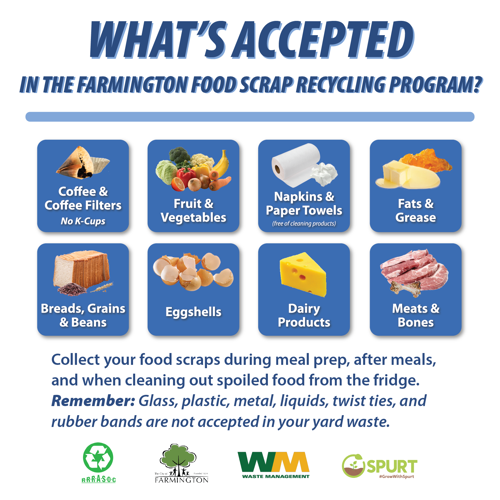
You can now include Food Waste with your Yard Waste Recycling. This new initiative allows residents to place household food scraps directly into their yard waste containers for weekly curbside pickup. Instead of sending organic materials to landfills, where they generate harmful greenhouse gases, residents can now help transform these materials into nutrient-rich compost used in gardens, landscaping, and city projects.
Food is the single largest category of material found in U.S. landfills. Once buried, it breaks down into potent gases such as methane. By composting food scraps alongside yard waste, the city will help reduce emissions while producing a valuable soil amendment.
A Proven Model for Success
The City of Farmington previously partnered with RRRASOC and My Green Michigan in a Food Waste Pilot Program launched in fall 2025. The pilot, staged at Riley Park, operated successfully through fall and winter. Since the start of the program, residents diverted nearly 22,000 pounds of food waste from landfills. Last year, the City’s overall recycling rate of 49.3 percent—significantly higher than the Michigan average of 25 percent and the national rate of 32 percent. The program demonstrated strong community participation and measurable environmental impact.
How Residents Can Participate
The process begins at home. Residents can collect food scraps in the kitchen and add them to their yard waste container or paper yard waste bags.